

College of Social Science students awarded at MSU Honors College Annual Diversity Research Showcase
February 2, 2026 - Jalen Smith
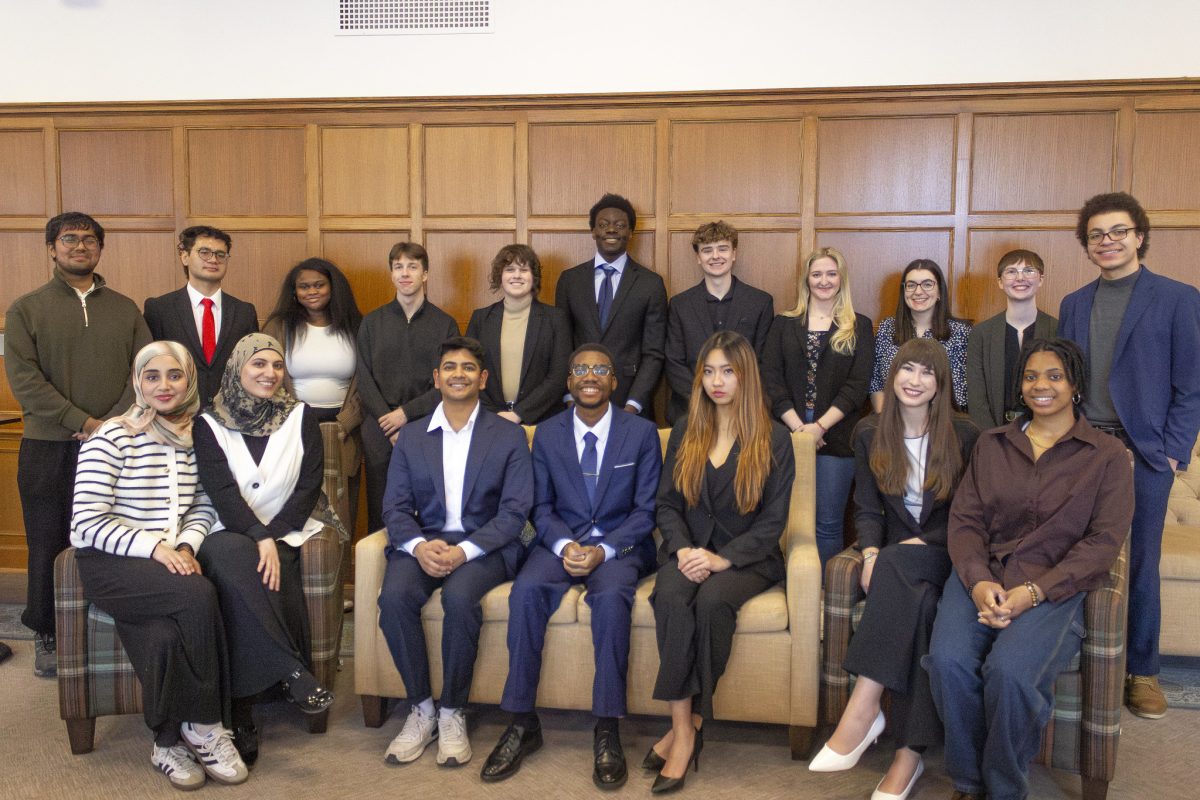
On January 23rd, The Michigan State University Honors College held its 9th annual Diversity Research Showcase in Campbell Hall. 11 College of Social Science students were among the 40 undergraduate participants that presented both in-person and online. Research topics ranged across a multitude of categories including mental health, world politics, and social justice.
Sociology/arts & humanities third-year student Alana Mapp won first place and $750 in the poster/online category for her research with fellow arts & humanities student Kellsey Hall entitled “RCAH Sister Circle as a Third Space: How Does Sister Circle Impact the Sense of Belonging in Women and Women of Color at Predominately White Institutions Like MSU?”
“The purpose of this research project is to observe the RCAH Sister Circle's effectiveness in creating a safe third space for women of color in a predominantly white institution and the transition of the space cultivated based on administrative attacks on Diversity, Equity, and Inclusion. Questions this project aims to answer are: How does third spaces like RCAH Sister Circle foster a safe environment for participants? How can mentoring programs effectively organize and advertise when there are restrictions and regulations on language? To what extent did the implications of not programming for protected identities impact student engagement in community focused programming like the Sister Circle? And in what ways did the effectiveness of RCAH Sister Circle’s goals change? The data used to answer these questions consisted of interviews with RCAH Sister Circle members, feedback forms, and attendance,” Mapp explained.
In addition to Mapp’s win, third-year world politics student Lowell Monis won second prize and $600 in the poster category for their project, “The Chance to Buy an Illegal Drug: Disparities in Exposure Across Race-Ethnicity Subgroups Over Time, 2002–2024.”
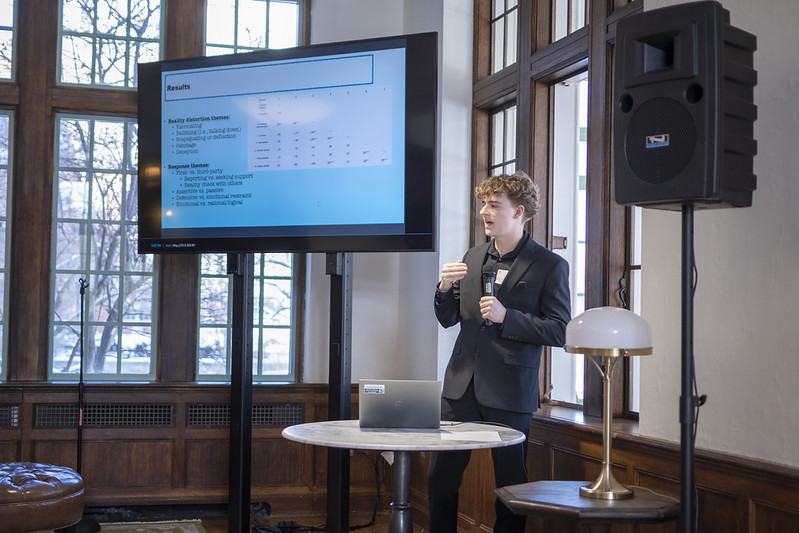
In the oral/in-person presentations, third-year public policy/neuroscience student Alexandra Beck took second prize and $600 for their project titled, "Birth and Barriers: Examining Perinatal Mental Health and Opioid Crisis and Treatment Availability," while second-year psychology student Liam Peck tied for third prize and $450 for his project, “Distorted Realities: Mechanisms and Response Strategies for Workplace Gaslighting.” Additionally, fourth-year psychology student Aesha Zakaria alongside second-year human biology student Ayah Al-soofi took fifth prize and $150 for their project, “Prenatal Healthcare Experiences for Women in Iraq.”
A full list of winners can be found here.
Provost Laura Lee McIntyre, Ph.D., congratulated the presenters on “pushing the bounds of research and understanding, and leading the way to real-world impact.”
“Thank you to the Honors College and their campus-wide partners who have supported your work and helped make this opportunity possible,” said McIntyre in virtual remarks.
Erika Crews, the Honors College director of student success and community engagement and served as a main organizer of the showcase.
“Diversity research helps us better understand the realities of our communities and the systems that shape them,” Crews said. “Especially now, funding this work is a meaningful investment in rigorous scholarship that informs practice and contributes to more equitable outcomes.”
A full album from the event is available courtesy of the Honors College and photographer Sloane Barlow. Those who wish to support next year’s Diversity Research Showcase are invited to contact Erika Crews at ecrews@msu.edu.
The subjects’ views in this article are their own and do not necessarily reflect those of the College of Social Science.