

Access Torch: Jessica Saba
April 20, 2026 - Emily Jodway
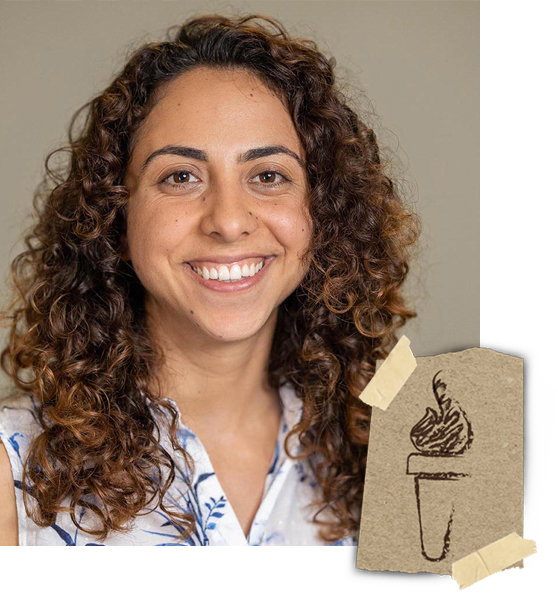 This April, we recognize Arab American Heritage Month and the many contributions and achievements of Arab Americans in the past and present. We also spotlight members of the Michigan State community who hold this proud heritage and are doing work that advances the lives of these individuals. Jessica Saba is a PhD student in the School of Social Work whose research focuses on advancing health equity among the Middle East and North Africa population and stories of resilience in Palestine.
Saba herself is Palestinian; her father came to America after being internally displaced in the 1967 war. Her own roots motivated her to learn more about international relations and humanitarian services as the conflict in Palestine intensified. She majored in Peace and Conflict Studies and minored in Arabic at UC Berkeley.
At first, Saba wasn’t aware of the field of social work, but as a McNair Scholar, she was introduced to undergraduate research and joined a project led by faculty in Berkeley’s public health and social work joint program.
“I liked social work’s mission and its focus on social justice,” she said. “The fact that you can gain interpersonal skills, focus on research, work at the public policy level … it really drew me in.”
During her gap year before going on to earn her MSW, Saba earned a grant to conduct a participatory action research program with young girls living in a refugee camp in Bethlehem. The project was focused on youth participatory action research, a concept she learned about as a McNair scholar.
“It’s hands-on teaching members of the community about research, so that they can think about and reflect on the issues most impacting their daily lives and learn how to take action in addressing it,” Saba explained. “It’s a very empowering, community-led form of research that I was really inspired by.”
After earning her MSW, Saba worked as a school social worker in the Los Angeles Unified School District, but found herself missing the research-centered aspect of her previous studies and chose to return to school to earn her PhD. “I was hoping that through a PhD, I could learn more about how to alleviate suffering at a larger scale and examine the root causes of societal issues,” she said.
Saba chose Michigan State in part because her partner had recently been accepted here for his own studies. “I was pretty afraid of the cold weather, but it’s grown on me now that I’m in my seventh year, and Michigan has really become my home,” she said.
Saba highlighted two projects in particular that have shaped her research at MSU. Both were centered on individuals who identify as Middle Eastern and North African (MENA). The first project, led by Dr. Rebecca Karam with faculty in sociology, global studies, and anthropology was titled, "Count MENA In," and sought to survey MENA faculty and students in an effort to identify their strengths as well as their needs as a marginalized group on campus. She currently supports the SAWA Center- ‘sawa’ meaning ‘together’ in Arabic, led by Dr. Nadia Abuelezam in the College of Family Medicine.
“It’s part of a nationwide effort to connect with community-based organizations and talk about the MENA community’s biggest issues in order to understand their needs and what we should be prioritizing in our research, programming, and policies,” she explained.
Saba’s dissertation, which she will defend this April in advance of graduating in May, examines the experiences of Palestinian women living in the West Bank and highlights stories of everyday resistance. A Palestinian woman herself, these conversations resonate deeply with Saba and inspire her to continue to share their stories through her research.
Among the harrowing and often traumatizing stories these women shared with Saba, an underlying theme stood out: the spirit of sumud. Sumud is an Arabic term and a core Palestinian cultural value that embodies resistance to erasure among its people.
“It’s them saying, ‘We are here, we will remain here, and we know that one day we will be free, and we won’t have to live in constant fear for our family’s wellbeing,’” Saba explained.
Women spoke of the things they would do each day differently if they weren’t living under occupation, and their hopes for the future. “There was this fierceness shown in the dreaming of what could be. Even amidst the horrors, there is still so much hope and strength and love for the home of Palestine and its people.”
After graduation, Saba hopes to continue researching the Palestinian diaspora and stories of resistance, coupled with MENA health equity-centered work and clinical social work as a licensed therapist. Celebrations like Arab American Heritage Month, she says, are “Great initiatives and ways to share these stories and this research.”
“It’s highlighting in a positive way the strengths of this community and the diversity within it,” she added.
Saba hopes that we can continue to foster inclusion efforts in our daily lives that support this population and other minoritized groups. “Day to day, I think about true inclusion, the kind that is sincere and real and welcomes people in their full humanity,” she said. “It sounds simple, but it doesn’t always happen. Hearing about Arab experiences and including them in classroom curriculum and discussions really goes a long way.”
Honorees’ views are their own and do not necessarily reflect those of the College of Social Science.
Read more:
Access Champion
Faculty/Staff
Kari Kammel
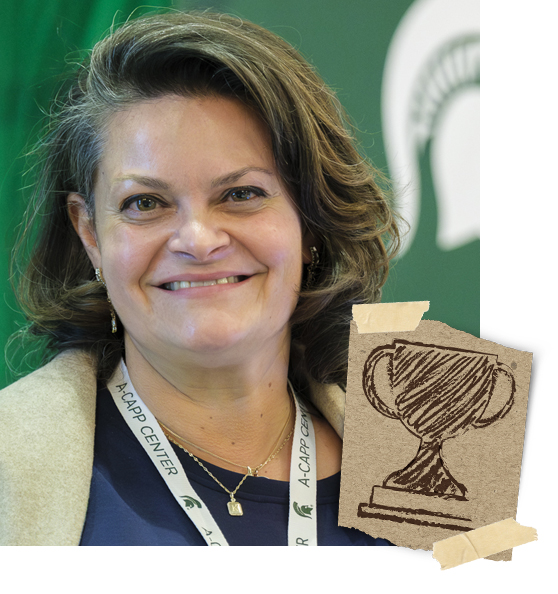
Kari Kammel is the Director of the Center for Anti-Counterfeiting and Product Protection (A-CAPP) at Michigan State University, where she leads the center’s research, education, and outreach initiatives and oversees its Industry Advisory Board and four brand protection councils.

Access Spotlight
Alumni
Isha Abbasi
Isha Abbasi is a 2017 graduate of Michigan State with a degree in Community Governance and Advocacy. She attended law school at the University of Michigan and currently lives in Chicago, Illinois. Abbasi has extensive experience in corporate law and commercial litigation, immigration law and public service work.

Access Matters
We strive to cultivate an inclusive and welcoming college environment that celebrates a diversity of people, ideas, and perspectives.