Jump to HeaderJump to Main ContentJump to Footer
Michigan State University
College of Social Science
  • Future Students
  • Undergraduate
  • Graduate
  • Degrees
  • Directory
  • Give

College of Social Science

  • Academics
    • Overview
    • Majors, Degrees & Programs
    • Undergraduate
    • Graduate
    • Advising
    • Career Development
    • Scholarships
    • Study Abroad/Away & Internships
    future-students

    Future Student Information

    Your future begins here
  • |
  • Research
    • Overview
    • Centers, Institutes & Programs
    • Faculty Initiatives Fund
    • Forms & Resources
    • Research Committee
  • |
  • Faculty & Staff
    • Overview
    • Policies & Forms
    • RPT Process
    • Support Student Careers
    • PAL Program
    • Services & Assistance
  • |
  • Alumni
    • Giving Opportunities
    • Career Development Assistance
    • Volunteer Opportunities
    • Alumni Awards
    • Blanchard Public Service Forum
    WLI-2-800w

    Learn about the WLI

    Visit Women's Leadership Institute
  • |
  • News
  • |
  • Events
  • |
  • Access
    • Overview
    • Dean's Research Associates (Postdoc) Program
    • Dean’s Institutional Access Small Grant Program
    • Access Accolades
    • Belonging Gatherings
    • Dean's Distinguished Senior Scholars Program
    • Dean’s Institutional Access Fellows Program
    • Advisory Committee
    essentials-corner

    Essentials Corner

    View Essentials Corner
  • |
  • About
    • Overview
    • Dean's Office
    • Leadership
    • Directory
    • College Awards
    • Contact Us
College of Social Science
  • Academics
  • Research
  • Faculty & Staff
  • Alumni
  • News
  • Events
  • Access
  • About

< Academics

  • Overview
  • Majors, Degrees & Programs
  • Undergraduate
  • Graduate
  • Advising
  • Career Development
  • Scholarships
  • Study Abroad/Away & Internships
future-students

Future Student Information

Your future begins here

< Research

  • Overview
  • Centers, Institutes & Programs
  • Faculty Initiatives Fund
  • Forms & Resources
  • Research Committee

< Faculty & Staff

  • Overview
  • Policies & Forms
  • RPT Process
  • Support Student Careers
  • PAL Program
  • Services & Assistance

< Alumni

  • Giving Opportunities
  • Career Development Assistance
  • Volunteer Opportunities
  • Alumni Awards
  • Blanchard Public Service Forum
WLI-2-800w

Learn about the WLI

Visit Women's Leadership Institute

< News

< Events

< Access

  • Overview
  • Dean's Research Associates (Postdoc) Program
  • Dean’s Institutional Access Small Grant Program
  • Access Accolades
  • Belonging Gatherings
  • Dean's Distinguished Senior Scholars Program
  • Dean’s Institutional Access Fellows Program
  • Advisory Committee
essentials-corner

Essentials Corner

View Essentials Corner

< About

  • Overview
  • Dean's Office
  • Leadership
  • Directory
  • College Awards
  • Contact Us
  • Future Students
  • Undergraduate
  • Graduate
  • Degrees
  • Directory
  • Give

Academics

  • Majors, Degrees & Programs
  • Advising
  • Scholarships
  • Experiential Learning
  • Student Success & Help Rooms
  • Career Development
  • Graduate
  • Future Students
  • Professional Licensure and Certification

Faculty & Staff

  • Policies & Forms
  • Reappointment, Promotion, & Tenure
  • Services & Assistance
  • PAL Program
  • Support Student Careers

Research

  • Centers, Institutes & Programs
  • Faculty Initiatives Fund
  • Forms & Resources
  • Research Committee

Access

  • About
  • Advisory Committee
  • Dean's Research Associates (Postdoc) Program
  • Dean's Fellows Program
  • Senior Scholars Program
  • Small Grants Program
  • Access Matters Accolades
  • Essentials Corner
  • Belonging Gatherings

Alumni

  • Giving Opportunities
  • Volunteer Opportunities
  • Career Development Assistance
  • Blanchard Forum
  • Alumni Awards

About

  • College Awards
  • Contact
  • Dean's Office
  • Directory
  • Leadership
  • Procedures & Codes

Contact us

(517) 355-6676

Address

Berkey Hall 509 E Circle Dr East Lansing, MI 48824

Follow Us

  • Visit our Facebook page
  • Visit our page on X
  • Visit our Instagram page
  • Visit our LinkedIn page
  • Visit our YouTube page

If you're having accessibility issues, please let us know.

Know MoreTransparency Reporting: Budget & Salary/Compensation
  • Contact Information|
  • Site Map|
  • Privacy Statement|
  • Site Accessibility|
  • Call MSU: (517) 355-1855|
  • Visit: msu.edu|
  • Notice of Nondiscrimination|

SPARTANS WILL|© Michigan State University|

Research

May 2, 2025

MSU Department of Sociology and Future of Work Initiative host lecture with author Allison Pugh

Emily Jodway Patyna

FOW_Pugh-6899


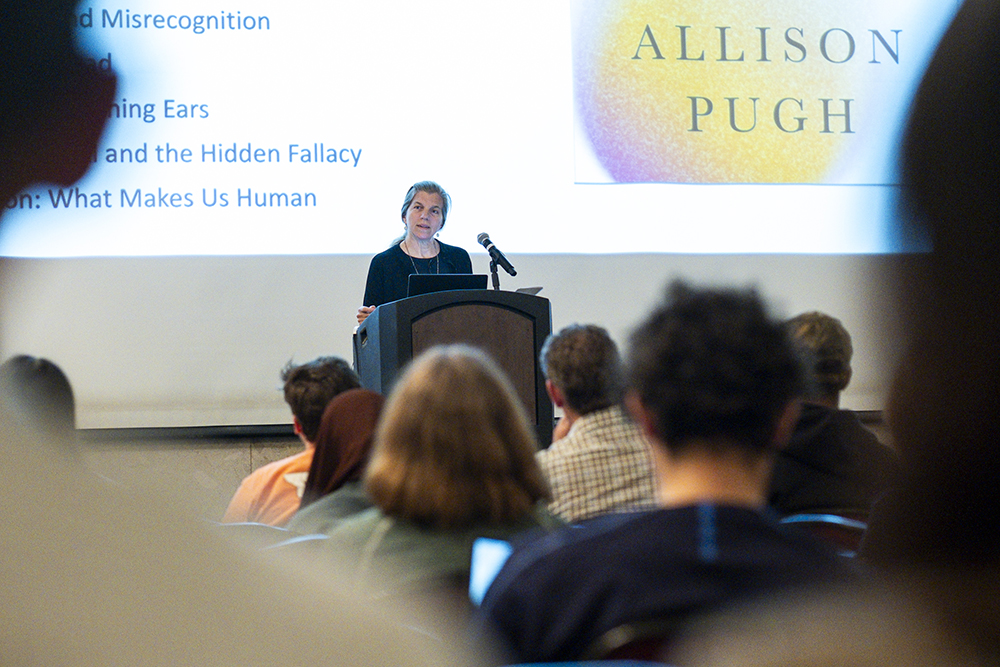
The Michigan State University College of Social Science welcomed bestselling author Allison Pugh to campus on April 22 for a lecture and Q&A session regarding new book, “The Last Human Job: The Work of Connecting in a Disconnected World.” The event was sponsored by the Future of Work Initiative and the Sociology department, and brought together students and faculty interested in learning more about the ways in which technology and work are changing and evolving. 

Pugh is a Professor of Sociology at Johns Hopkins University and writes about how people forge connections and find meaning and dignity at work and at home. Her newest book explores the human connections that underlie our work, arguing that what people do for each other in these settings is valuable and worth preserving, especially as advancements in Artificial Intelligence software and its role in society are becoming a topic of serious conversation. 

With this book, Pugh sought out to find the answer to what it means to be human, what humans do for each other, and how machines shape the future of human work. She argues that while AI has opened up our world to new discoveries and ways of doing things, it cannot replace interpersonal interactions and human connection. She has coined the term ‘connective labor’ which refers to the forging of an emotional understanding of another person in order to create valuable outcomes. 

“Connective labor is the work of seeing the other person and having the other person feel seen,” Pugh said. 

This ability is unique to humans, and is at risk of being phased out through the mechanization of work stemming from an increasing push to make systems more efficient, productive and profitable. 

“I’m all for it in these non-connective areas,” she said, citing the use of AI for recent discoveries in language, medicine and data organization. “But, humans connecting to other humans is what we do well, and even more than that, it’s what’s important, it’s what’s meaningful, it’s what makes us human.”

Pugh conducted interviews with over 100 people, from school counselors to medical practitioners, animal trainers, hairdressers, therapists and teachers, along with hundreds of hours of observation in classrooms, doctor’s offices and other professions that heavily rely on connective labor. Many of those interviewed came to similar conclusions. While connective labor involves its fair share of risks, such as an individual’s capacity for empathy and the inherent imperfection that goes along with being a human being, these hurdles are greatly outweighed by the reward- the power of collective labor, of truly knowing and understanding one another, the basic tenets of a fully-functioning society. 

“Humans can be messy and complicated, and that’s a problem for a lot of connective labor,” said Pugh. “I see the harms that can come from the unpredictability and variability of humans, but that very variability is also what makes connected labor valuable and have its own impact.”
FOW_Pugh-7077

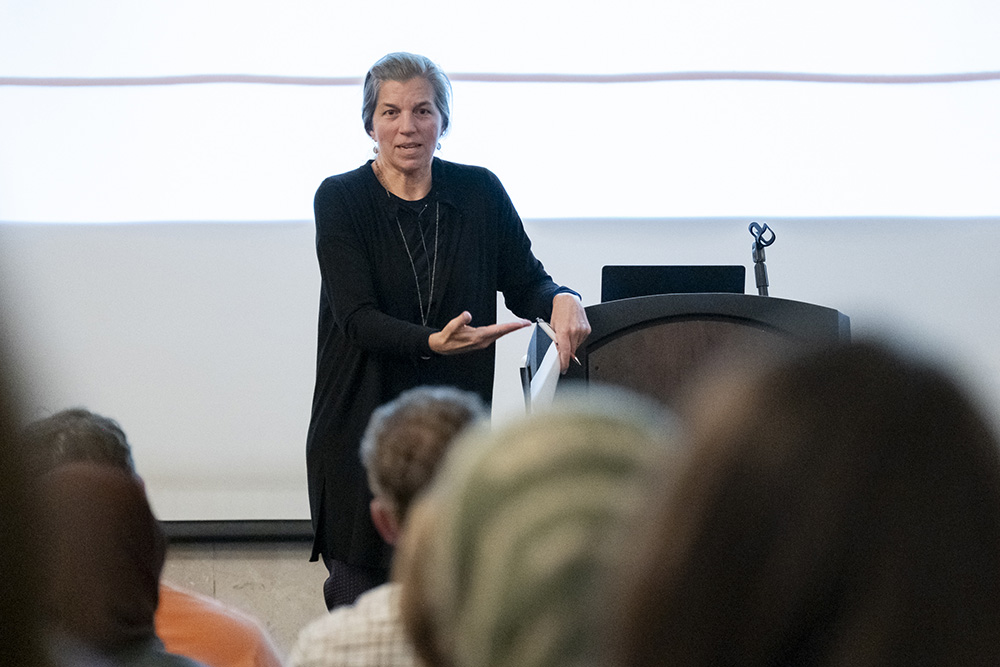
While there are cases in which AI can be helpful in providing social interactions for those seeking  judgement-free advice or an anonymous source to vent their feelings to, it is a hollow excuse for true human interaction, Pugh explains. Conversation with other humans adds an additional layer of vulnerability, but also deep connections and a building of trust. Opening up to someone can be an anxiety-inducing task for many individuals, but is ultimately beneficial- humans motivate other humans, and connecting with one another, even in the worlds of commerce and civic society, is what forges communities and creates our world. 

“What is missing when it’s a bot that sees us is the messiness, the unpredictability, the spontaneity of interacting with a human being, all aspects that force us to develop flexibility and compromise, humility and adaptability, all muscles that we need to exercise,” Pugh explained.

Pugh wrapped up the lecture with advice for the future. She suggests added transparency surrounding the use of AI in the workplace, as well as utilizing it in tandem with human leadership and a dedicated social architecture that enables us to still maintain a connected culture. 

“Seeing others and being seen involves imagination, danger and vulnerability, coming to terms with the unpredictability of our fellow humans. But it is part of human existence. It is how we understand ourselves, create connections, forge community, conduct democracy. It is what humans do for each other, and it is what makes us human.”

Photos by Jacqueline Hawthorne.

Research