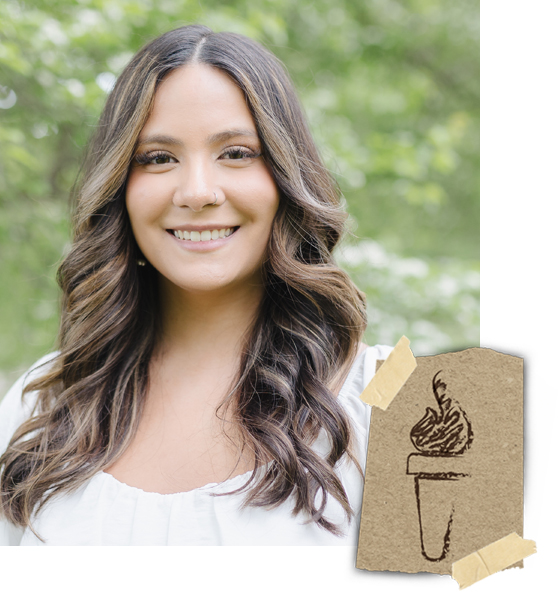
Natalie Rivera is a doctoral student in the School of Criminal Justice and Chicano Latino Studies Program at Michigan State University. She is actively involved in the Chicanx/Latinx Association on campus and is the Chicano Latino Studies program representative for the Council of Graduate Students. Rivera’s research examines instances of gender-based violence, victimization, and the correctional experiences of individuals within marginalized communities. She is our Access Torch honoree for September and our celebration of Hispanic Heritage Month.
Spaces like the Council of Graduate Students (COGS), of which she is the Chicano Latino student representative, and the Chicano Latino Studies program itself, help to bolster that connection.
Rivera was originally interested in meteorology, choosing to head west from her hometown of Chicago to Iowa State to study weather events. But upon taking a Psychology 101 class, her interests began to change. Switching her major to psychology and taking a variety of classes, including a course about psychology and the law, she also developed an interest in criminal justice and added it on as a minor. During this time, Rivera also took a Latinas and Victimization course through Iowa State’s US Latino Studies program, introducing her to the idea of Chicano and Latino studies with a psychology and criminal justice-based approach.
All of these things were new and eye-opening experiences for Rivera as a first generation college student. Her grandparents on both sides of her family immigrated to the United States for work and opportunities, and she grew up in a bilingual and bicultural household that celebrated Hispanic traditions and holidays. Initially, it felt strange to Rivera to want to pursue higher education.
“I was an only child, and I always saw people working,” she explained. “My grandparents both worked, my mom was always working … I kept seeing these grown-up people do grown-up things, and I felt like I needed to do the same. Education wasn’t necessarily on my forefront.”
But after discovering her true interests in undergrad, Rivera made the decision to also pursue a master’s and eventually a doctoral degree. Michigan State was not originally a school she thought about attending, but she was interested in some of the work faculty members like Drs. Jennifer Cobbina-Dungy and Merry Morash were doing in the School of Criminal Justice.
“They were doing a lot of community-based work and that was important to me, working with communities and people that need assistance and guidance,” she said.
Rivera continued to pursue the research in Latino/a violence and victimology that she began at Iowa State. Underrepresentation persists in the examination of victimization and gender-based violence through a Latino/a lens and representation of Latino/a law in criminal justice, according to a report by the Government Accountability Office, and Rivera wants to change this. An independent study researching the Latino/a population and victimization in rural Iowa inspired her to continue this work at Michigan State, and she is currently developing a survey centered on Latino/a individuals and their experiences with interpersonal violence.
“Doing that independent study, I then wanted to know what this looks like in an urban setting, in a different city, in a different state …. I wanted to keep pursuing this area because of that class,” she said.
Rivera’s interest in incarceration, correctional facilities and rehabilitation programs stems from her own personal experiences. Her father was incarcerated when she was young. “I wanted to know, because I was so little when he was incarcerated, what he went through and what it was like for him,” she explained. “You really don’t know much about incarcerated populations unless you’re researching them and talking to them about what their experiences are.”
Her time on a National Science Foundation research project gave her the chance to engage in these firsthand accounts of incarcerated life from individuals recently released and navigating through societal reentry, probation and parole. Rivera and her fellow researchers found that in many cases, there is a lack of funding and resources proportional to the volume of people being released and needing rehabilitation each year. “Being able to hear the experiences of people going through that, how they’re dealing with life on the outside, and if they’re succeeding or not was very eye-opening,” she said. “That was my first time realizing how the criminal justice system works, and how it impacts people and communities.”
Rivera is also passionate about inclusion and fostering a sense of community among her fellow graduate students at Michigan State. Dealing with her own feelings of loneliness and imposter syndrome arriving on campus as an out-of-state and first generation student, she committed along with others to fostering a community, a home away from home for their peers. When she was conducting research for her project, "The Case for Integrating Diversity, Equity, and Inclusion into Criminology and Criminal Justice Doctoral Programs,” she interviewed Latino/a students about their experiences in higher education and ways that inclusion could be improved. After the study was completed, the group kept in contact.
“We started getting contact information and network building to make sure that we didn’t keep feeling isolated, and sharing the things we are feeling as a group, talking about them. It was nice because it went beyond just research, into creating connections and making sure that everyone was okay, and building those resources off of our shared realities.”
It’s important to Rivera to be an example of just one of the many ways of becoming a successful individual and honoring one's heritage at the same time. Her story is both similar to and unique from that of a family of immigrants beginning a new life in the United States.
“Being able to show that Latino/a individuals grow up in different spaces is important to take into consideration especially when it comes to American life and working within academia, public policy and research,” she said. “Understanding the epistemology, the resilience and leadership that our community has … I try to ground that into my work to ensure that Hispanic and Latino/a experiences are not just added on, but actually taken into consideration from the ground up.”
Especially around Hispanic Heritage Month, Rivera also thinks about her own personal responsibility to both celebrate Hispanic culture and share the ways that the Latino/a community is inherently valuable to society as a whole.
“It's about showing that we're here, that it's about the progress that our communities have made, but also recognizing that there are structural barriers and things that still remain, and to address those. We are celebrating that we are doing amazing things, but most importantly, we're being responsible and recognizing that there's still work to be done.”
Honorees’ views are their own and do not necessarily reflect those of the College of Social Science.