Throughout the month of May, we celebrate Asian Pacific Islander Desi American/Asian (APIDA/A) Heritage Month and highlight the important role that the members of this community have played in our shared history. We also spotlight members of the MSU community who strive to uplift these individuals and advance belonging through research and advocacy.
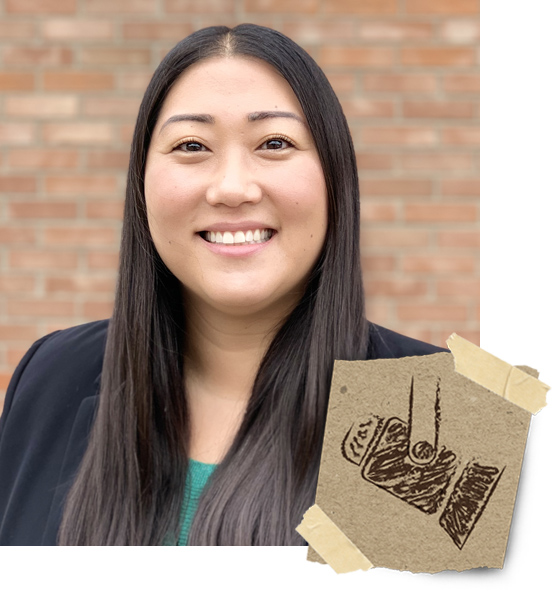
Our May Access Spotlight is Brady Velazquez. Velazquez is a graduate of Michigan State with a degree in Interdisciplinary Studies (Community Relations and Sociology) and currently serves as Equal Opportunity Coordinator for the Office for Inclusive Excellence and Impact.
Velazquez found her home at Michigan State and within the College of Social Science after initially planning to one day become a veterinarian. After having second thoughts, she spoke with an undergraduate advisor and shared her passions for helping people and animals and understanding the world around her. They suggested she major in Interdisciplinary Studies.
The College of Social Science was one of many homes away from home for Velazquez at MSU. She also joined the alpha Kappa Delta Phi International Sorority, Inc. and the Asian Pacific American Student Organization (APASO). “That was when I really started learning about grassroots organizations and what it means to advocate and build community,” she said.
Another group on campus that was especially meaningful to Velazquez is the Student Korean Adoptees Association. Velazquez was adopted from South Korea as an infant; her sister was also adopted from South Korea and her brother from Colombia. The group brought together a unique group of individuals- students who were Asian American who weren’t necessarily raised by Asian American parents or exposed to Asian American culture growing up.
“It was great, because we all came from different backgrounds,” Velazquez said. “We all have very different experiences, but this was a space where we could really re-center ourselves.”
After graduating and spending several years working in the municipal and nonprofit sectors, Velazquez felt it was time for a change. Her husband had been working at MSU for many years and suggested she look into openings on campus. Velazquez had stayed involved by forming the APIDA Spartans alumni group in 2020, and when a job opened up in the Office for Inclusive Excellence and Impact, Velazquez immediately applied.
In her current role, Velazquez supports outreach, engagement and community-serving efforts as well as assisting with institutional policy and legal compliance projects. She appreciates the continuing education she receives in this role, learning more about the legal aspects of equal opportunity, and being able to coordinate events across campus.
“When I was working in a nonprofit, I was helping out with events often, and being able to utilize those skills to advance belonging and inclusion here at MSU is very meaningful to me,” she said.
Velazquez’s journey to finding belonging on campus has greatly inspired her to help others find their own spaces in which they can thrive. “In order for students to succeed, they need to feel like they belong,” she explained. “Everybody should feel that sense of belonging when they come to MSU.” This extends not only to students, but faculty and staff as well, she adds.
Velazquez says her own heritage and identity inform how she interacts with others both in her role on campus and in the greater community. She is an Asian American woman, but also an adoptee, which offers a unique lens to how she cultivates her own sense of cultural identity.
“It’s really helped me to be mindful of the way I interact with people and communities,” she said. “You never know what people are going through, where they’re at in their journey. It’s important to me to meet them where they’re at and be a part of their support system.
Velazquez stays involved with the Asian Pacific American Student Association and is active in event planning on campus each May during APIDA/A Heritage Month. She is the faculty advisor for APIDA Celebratory, a group that connects APIDA students with other faculty, staff and members of the APIDA community. She believes that bringing recognition to this community through education and highlighting the role APIDA individuals have played in American history are a few ways that we can raise awareness during APIDA/A Heritage Month and beyond.
This rings true not only for the broader community, but APIDA individuals themselves as well: “If you don’t know your history, it’s hard to have cultural recognition and pride,” she said.
“When people see these histories on their campus and take these classes and learn more about themselves or about others, it can help us address inequality, promote inclusivity and belonging, and ensure that we are all experiencing life through a variety of diverse perspectives.”
Honorees’ views are their own and do not necessarily reflect those of the College of Social Science.