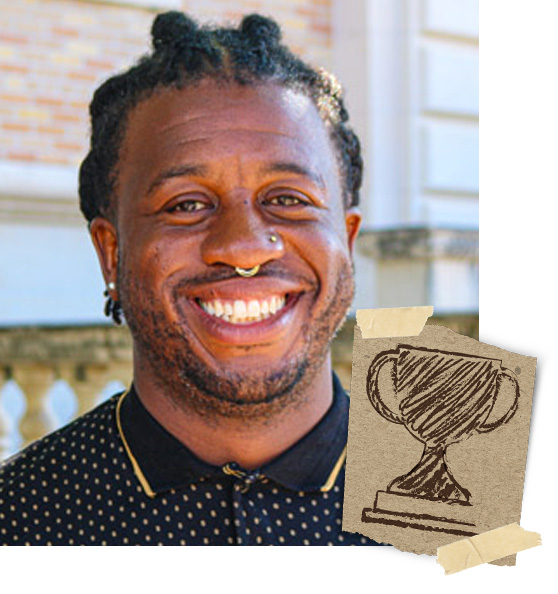
Throughout the month of June, the College of Social Science celebrates Pride Month and highlights the work that our students, faculty and alumni are doing to support and uplift the LGBTQ+ community. Our June Access Champion is Gabriel Johnson, a recent graduate of the Dean’s Research Associates Program (DRAP) who will enter his first semester as an Assistant Professor in the School of Social Work this fall.
Johnson's research focuses on Black masculinity as an intersectional and dynamic social construct and its influence on the health of men and boys, including gay, bisexual, and queer individuals. He was influenced in part by his own experiences growing up and time spent working as a harm reduction specialist. He was introduced to the possibility of studying Black masculinity in the context of public health research during his time at the University of Michigan.
“Growing up as a Black queer man put me into a position to center my research on the experiences of this community,” he said. “Their perspectives are incredibly beneficial to understanding Black masculinity and finding ways to mitigate adverse health outcomes and social conditions like discrimination.”
Johnson received both his PhD and Master’s of Public Health from University of Michigan before arriving at Michigan State. Johnson applied for the Dean’s Research Associates Program (DRAP) after hearing about it from one of his mentors, Dr. Daphne Watkins, who suggested that MSU and the DRAP would align well with his values and passion for both teaching and research.
During his time in the DRAP, Johnson was surrounded by a community of fellow researchers, faculty and administrators across disciplines. “Coming to MSU and into this community and having the university show a real investment in incoming faculty was something that I really appreciate and cherish,” he said.
As a first generation college student always seeking out new opportunities and guidance, Johnson said, “Learning about the different pathways that faculty and staff have taken to their current roles really helped demystify what the journey to becoming an administrator can look like.”
As an educator, Johnson seeks to inspire his students through engagement in the classroom and help them find communities of their own on campus in which they can thrive. One of his favorite parts of teaching is watching students grow in their abilities and creating safe spaces for them to explore outside of their comfort zones.
“I try to provide students with resources for building community and connection, whether it’s professionally or emotionally, and to offer additional opportunities by bringing other faculty and community leaders into the classroom for students to connect with,” he said.
This blending of academics with community interaction also plays a central role in Johnson’s methods of research. He pairs this with an interdisciplinary approach, working directly with researchers from across the university. “Practicality is the name of the game with the work that we do,” he explained. “Things are meant to be applied, they’re meant to be related to how we can enact change in community settings, individual settings, in a variety of different contexts.”
His research would not be possible without this interdisciplinary collaboration. “We’re focused on connections, and how we can connect across units to solve problems and strengthen programs and policies,” Johnson added.
Johnson can remember attending his first ever Pride celebration as a ‘young, Black queer kid’ in Minneapolis, and how powerful and transformative it was for him and thousands of others. “It can highlight the experiences and stress you’re holding in, but also help you recognize how incredibly joyous and relieving it is when you’re free to be who you are in spaces that are affirming.”
One of the many ways we can continue to advance belonging and promote environments like these, Johnson says, is by “Leading with curiosity over critique,” having open conversations and seeking to understand the rich individuality present among minoritized communities rather than “generalizing.”
“I think if we can foster that, while also speaking up and supporting work that provides support, integration and connectedness among LGBTQ+ folks and their families and communities, that’s how we can really move forward.”
Honorees’ views are their own and do not necessarily reflect those of the College of Social Science.