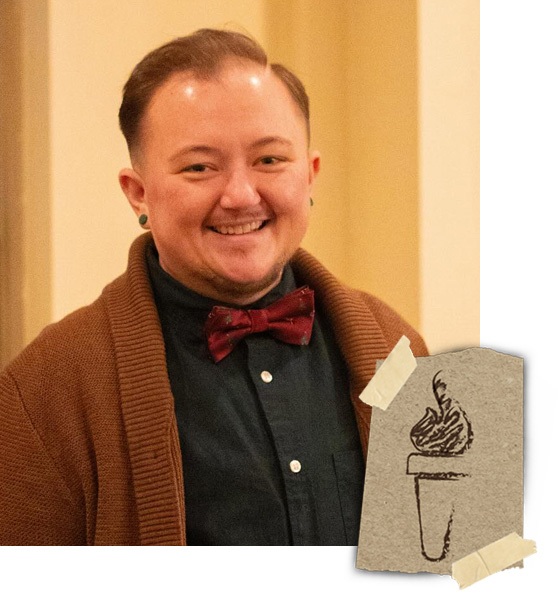
Throughout the month of June, the College of Social Science celebrates Pride Month and highlights the work that our students, faculty and alumni are doing to support and uplift the LGBTQ+ community. Our June Access Torch is Sterling Bentley, a doctoral student in the School of Social Work whose research centers around LGBTQ+ health equity and civic engagement within marginalized communities.
Bentley received his BA in sociology from the University of North Carolina Asheville in 2016 before coming to East Lansing in 2021 to earn his Master’s of Social Work. Bentley is a firm believer in the ability to create social change through social work practice. His professional background in community organizing began in response to anti-transgender legislation and continues to center on transgender justice through political and civic engagement strategies. He spent time between undergrad and earning his MSW doing community organizing and advocacy work in North Carolina.
The confidence Bentley built standing in front of legislators and sharing his own story led him to educate his community on ways in which they can advocate for themselves and humanize LGBTQ+ lived experiences.
“Engaging with legislators is not only a passion of mine but also a professional pursuit,” he said. “My goal is to make conversations with our elected officials less scary and to remind folks that they work in service of us, not the other way around.”
After several years of working alongside minoritized groups in his community and meeting local partners with social work backgrounds, Bentley made the decision to attend graduate school and garner more evidence-based research experience that would aid in his pursuit of combatting injustices and empowering marginalized communities.
Bentley was drawn to Michigan State after learning about the College of Social Science and School of Social Work’s Consortium for Sexual and Gender Minority Health. “I saw all of these faculty members and graduate students already having connections and community infrastructure through that group,” he explained. He interned with the consortium while earning his MSW and “fell in love” with community engaged and informed research.
Much of Bentley’s research done at Michigan State has involved direct conversations and input from the broader Lansing community. Last year, Bentley collaborated with other MSU students on the East Lansing Citizen’s Manual, an online hub designed to educate community members on local government issues and encourage active participation in shaping the city’s future. He is currently working on a community-academic partnership with the Michigan Organization on Adolescent Sexual Health (MOASH) seeking to improve public school sexual education in Michigan based on updated best practices and medical advances.
“We’re utilizing that intertwining of civic engagement and community partnering with doing academic work and writing manuscripts based on our findings,” he said. “We co-created policy briefs with MOASH to use to continue that education. It feels like it has a much larger ripple effect in the community. Seeing research reinforce what’s happening on the ground is always at the forefront of my mind.”
Bentley’s social work experience informs his research's aim to influence policy and legislation in order to promote liberation and equity for all marginalized people. One of the driving forces behind his efforts is the idea of transgender and gender diverse resistance. It involves not only an acknowledgement of this community’s hardships and changes that still need to be made, but also a celebration of the rich history and culture the trans community contributes to our world.
“When I’m looking at resilience and resistance, it makes me really proud to be who I am and to share that legacy and resistance,” he said. “It also reinvigorates me and helps me recommit every day to bolstering those resistance practices and reminding myself that joy is a mechanism for resisting.”
Bentley has also done his part here at MSU to cultivate spaces in which gender diverse individuals can feel safe and welcomed. He was part of a multidisciplinary, university-wide research team that created the MSU LGBTQIA2s+ Student Climate Survey to gauge the effectiveness of current programs on campus designed to support these individuals.
This June, cities across the country will host their 5th, 25th, and even 50th annual Pride celebrations, while others are just beginning to implement these celebrations into their community. “That, to me, speaks to how far we’ve come, but also how far we still have to go,” Bentley said. “It’s all about honoring our past, celebrating our present, and looking to sustain our future.”
Our efforts can continue past Pride Month through active allyship and ongoing community engagement, Bentley added. Speaking up in the face of prejudice, having conversations about the importance of inclusivity, and ‘just continuing to show up’ are a few ways in which we can accomplish this.
“It’s reminding the people in your life who hold these identities that not only do you love and see them, but you’re fighting for them, and there’s a space for them at our collective table.”
Honorees’ views are their own and do not necessarily reflect those of the College of Social Science.