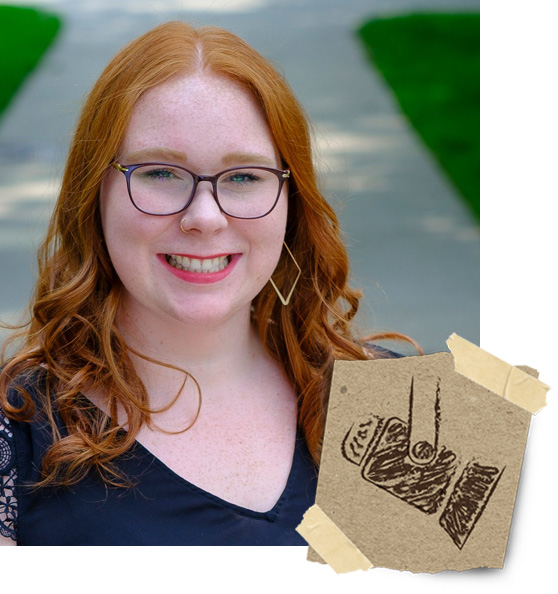
This July, the College of Social Science celebrates Disability Independence Day and recognizes members of the Michigan State community working to advance equity, belonging and independence among the disabled community. Our Access Spotlight for the month of July, Emily Jensen, is a postdoctoral researcher in Communicative Sciences and Disorders whose research centers around supporting children with special healthcare needs and their families in medical settings.
Jensen came to Michigan State to earn her PhD in Child Development in 2020 after receiving her bachelor’s degree in the same field of study from Central Michigan. She has been in a postdoctoral research position since 2025 with MSU’s Department of Communicative Sciences and Disorders in the Lingo Lab, under the supervision of Dr. Courtney Venker. Dr. Jensen’s work in the Lingo Lab focuses on investigating evidence-based practices in communication intervention for speech-language pathologists working with autistic children.
Jensen first became interested in child development after taking an HDFS course in undergrad and learning about the role of child life specialists in the medical world. “It really spoke to me because that’s what I had experienced growing up- being in medical settings as a child and feeling scared, stuck, like you’re not being listened to, and additional support from someone like a child life specialist would have really helped my family and I navigate that,” she explained.
Michigan State appealed to Jensen for earning her PhD after reading about all of the outstanding research being done by faculty and other students in this field. While earning her PhD, Jensen managed the Research in Autism and Developmental Disabilities (RADD) Lab with her graduate mentor, Dr. Sarah Douglas. “We really focused on supporting children with developmental disabilities and autism and their families,” Jensen said. This work has carried on into her current role in the Lingo Lab.
Much of Jensen’s research focuses on the direct experiences of disabled children and their families or caregivers navigating medical settings, and comparing this to what practitioners are taught in medical school about how to provide care for these individuals. Her findings have revealed a gap in education surrounding how to help families navigate these systems and care for their loved ones.
“That was really startling- we know people with disabilities exist, they’ve been here forever and aren’t going anywhere, so why are we not teaching our medical providers to provide the best quality care to this specific population?” Jensen said.
Along with implementing a greater focus on interpersonal ‘soft’ skills in addition to clinical skills- Jensen says, “Caregivers tell us they want someone who is knowledgeable and up-to-date but who also listens to them and makes them feel like their child matters,”- the medical environments themselves could use an update to make them feel more warm and welcoming.
“Hospitals and medical systems tend to be very sterile and off-putting, and that can be scary for a child and even for adults,” she explained. This fear is further compounded when a child or adult has a disability.
This requires buy-in from more than just caregivers and providers. “Systemically, we need legislation and governmental action that supports people with disabilities and provides funding for this research and training, and continues to provide the safety net and support that people with disabilities and their families really need,” said Jensen.
Training providers while giving families and caregivers the tools and resources they need can also aid in efforts to increase independence among the disabled community. “Allowing that self-determination and for [the disabled person] to make as many decisions in their own health care as possible, and empowering families to do that too, would be very significant for a lot of people,” Jensen explained.
Hearing from the disabled community themselves throughout the research process, as well as communicating findings and results, also contributes to this mission.
“Most of my research is qualitative and really focuses on being community-engaged,” Jensen said. “I’m doing research not only for other academics to read and cite, but for the sake of improving practice overall.”
Disability Independence Day gives us an opportunity to reframe how we think about disability and to redefine it as a difference, rather than a disadvantage or detriment. “A lot of my work has been focused on seeing disability as an aspect of diversity,” Jensen said.
“Disability is a difference, but it’s also a community and a culture, and a really beautiful one at that. I think it’s helpful for all of us to be more inclusive, to learn more about this culture and to work through some of our own implicit biases so that we can continue to drive systemic change.”
Honorees’ views are their own and do not necessarily reflect those of the College of Social Science.