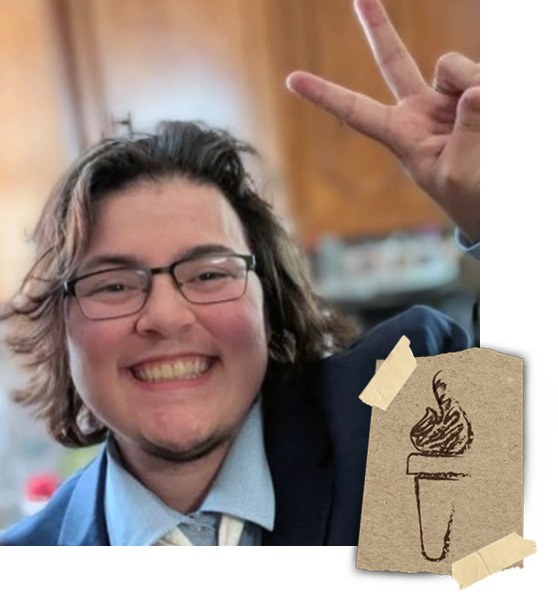
This September, we celebrate Hispanic Heritage Month and honor members of the Michigan State community making efforts to advance access and belonging among this group. Our September Access Torch is Miguel Logan Treviño-Fica, a dual-major doctoral student in Chicano/Latino Studies and Sociology whose research explores sex, gender, race, ethnicity and social movements.
Originally from Grand Rapids, Treviño-Fica was at first interested in research centered around the biological aspects of transness. This eventually shifted into a desire to focus more on race and gender in a sociological context after taking some psychology and sociology courses and working with sociology professor PJ Pettis.
Treviño-Fica’s own experiences of growing up with intersecting identities greatly influenced his choice of study. “Because I’ve been existing in this space as a person who is queer and Latino, I’ve always been interested in the broader experiences of individuals who are on the borders and the margins, and what it means for them to exist in society,” he explained.
Treviño-Fica also draws from personal experience in his research of social movements. He is particularly interested in extremist anti-minority groups and exclusionary movements. Growing up in a predominately white area, Treviño-Fica found himself experiencing racism in evolving ways; as he has gotten older, he has become more ‘white-presenting’ in his looks.
“In particular, my mom is more visibly Latina than I am, so I’ve not only dealt with racism myself, but also racism against her as I’ve grown up,” he said. “I’m very passionate about improving the lives of Latino people because I’ve had those experiences.”
His research on extremist social movements centers around understanding how they form, how they function, and how they spread their viewpoints. “These groups have ideological goals that relate entirely to the expulsion of a particular minority from society, and understanding how these groups work- how they recruit, how they engage people in this ideology- is in part a way of preventing them from using this harmful ideology to influence others,” he explained.
Treviño-Fica is looking ahead to working on his master’s thesis, focused on the experiences of individuals who have de-transitioned. Being a part of the Chicano Latino Studies (CLS) program has been a highlight of his time as a postdoctoral student. He was first introduced to the program through Dr. Pettis. “It’s helped me a little bit with my impostor syndrome- my mother is Latina, she raised me with a cultural connection to being Latino, but I didn’t grow up around my extended family or in a Latino community,” he said. “By the time I was actually in a space where I had that, I had doubts about whether I was welcome. CLS has reassured me that I am. It is truly an absolutely fantastic space on campus.”
During Hispanic Heritage Month, Treviño-Fica would encourage individuals to look beyond the United States’s traditionally binary viewpoint of race. “The modern thought process is, we have the people who have been living here for centuries, and the ‘foreigners’ who have come here from another place- and those individuals are targeted just because of who they are,” he said. “Latinos, broadly, are treated like we don't belong here. We need to come together and show that we're a part of this local community, but also the entire community of American people."
Engaging in activism and with community groups who are ‘making an active effort’ to support these individuals is another way Treviño-Fica recommends getting involved during Hispanic Heritage Month. “A month spent celebrating the impact Hispanic individuals have had in the United States, the wonderful things that come from Hispanic culture, and our right to exist here is the best way to show our support to this community.”
Honorees’ views are their own and do not necessarily reflect those of the College of Social Science.