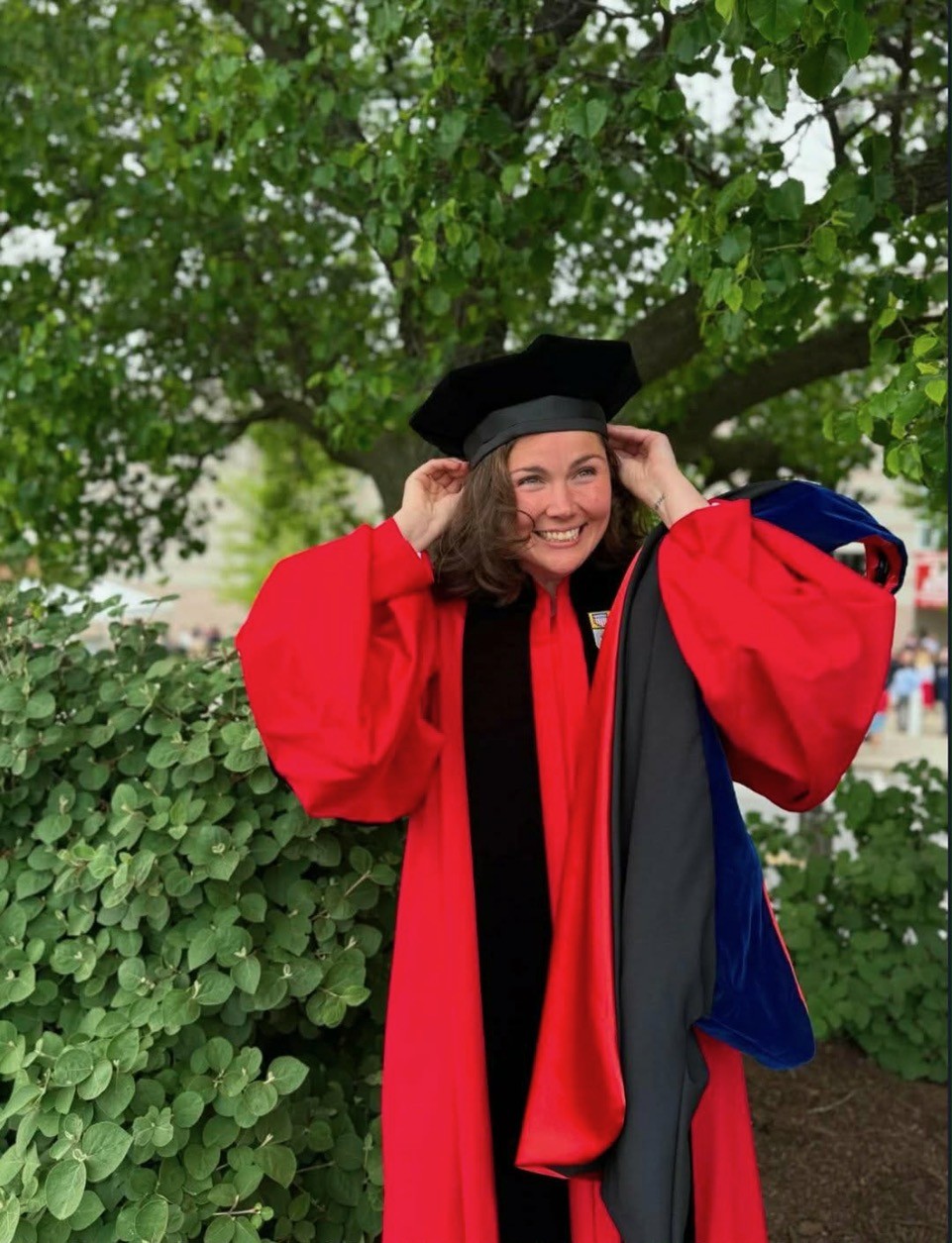
Grace Beals is a 2018 graduate of Michigan State University who earned a bachelor's degree in economics through the College of Social Science. She is currently a Postdoctoral Associate at Duke University and will begin teaching as an Assistant Professor of Public Policy at the University of New Mexico next fall. While at MSU, she was a member of the Social Science Scholars Program, Econ Scholars Program and Honors College. Grace's research focuses on the role of credit in bridging the gap between the labor market and the welfare state. She and her husband Evan have been married for over six years now and have two sons. In this spotlight, Grace shares how her experiences at MSU and in the Scholars Program helped shape her future and prepare to further her education.
What drew you to your career path? I was certain I wanted to go to graduate school pretty early in my undergraduate career. I had the opportunity to be a research assistant for a variety of professors at MSU, all thanks to the Scholars Program, and fell in love with research. I liked the nitty-gritty decisions and tedious work that went into solving a problem or answering a question. I realized that I wanted to be a professor rather than switch to industry when I started teaching and mentoring undergraduates.
Describe your research. Imagine you have a medical emergency and you don't make enough to pay for the hospital out of pocket, and your health insurance doesn't cover the full cost--you would likely use a medical credit card or some other private credit service to make ends meet. This tradeoff can be straightforward, but gets complicated when you don't have access to good credit, don't have access to welfare or face unexpected emergencies (ranging from COVID to hurricanes).
What was your educational route to your current role? I have a BA in Economics from MSU (and technically an additional major in Economic Geography), a MA in Analytical Political Economy from Duke, and my PhD in Government from Cornell. I firmly believe I wouldn't have been able to make the jump from MSU to Duke without the preparation I had from the Scholars program.
What advice would you give to someone else who wishes to emulate this career path? There is no one "right" way to do this, unfortunately! In fact, I would do things differently if I wanted to do it the right way and frontload a bunch of empirical courses. Instead, I took courses I was honestly interested in with professors whose teaching and research I still try to emulate (Christian Ahlin and John Waller are both huge inspirations to me!). I think you should use your time in undergrad to develop your skills in reading, writing, and empirics. Learn how to read a HUGE volume of work quickly and efficiently without AI. Approach writing and empirics, both qualitative and quantitative, as skills you will continue to develop at every step. Use extracurricular activities like internships and volunteering as a way to see what other career options are available and interesting to you.
Did you ever have to make a course correction in order to achieve your objectives? Absolutely! I was not sure if I wanted to go to grad school in econ or in political science (you'll notice I did not major in political science). I did my MA to figure out which one I was better suited for. I love both, but political science is a better fit for me.
What are some things interested undergraduates should know about applying for academic jobs? It is crazy out there! The best advice I received was to apply widely and to not count yourself out of a position simply because you didn't think you were what the hiring committee was looking for. The biggest emphasis will be on your job market paper and cover letter so fine tune these as much as you can. Remember that you are competing against a lot of other highly qualified people. At some point, you want to show people that you will not just be a good hire, but a good colleague.
What are the best ways for students to prepare themselves for going into academia? Reading widely and learning how to put authors/ideas in conversation with each other. Learning how to work hard when you have support (this will prepare you for later!). Being exposed to a variety of ideas and people--I firmly believe you can learn something from anyone ranging from workflow tips to more academic topics.
Tell me more about navigating the hidden curriculum of academia. This is everything from understanding what "optional" events are actually optional to figuring out what the dominant opinion on a scholars' work is. If you have lived in another country for several years this will be a familiar feeling--you get a sense that everyone else is speaking the same language and your dictionary isn't quite keeping up. Watching and listening to a variety of opinions and advice was very helpful for me. There will be other people who are also a bit lost too.
How do you manage instances of imposter syndrome? Imposter syndrome is the idea that everyone else made it to where you are because they deserved it and worked hard but you ended up there as a fluke. This isn't true and you should remind yourself of that. However, it will still crop up. The sooner I grew comfortable with the idea that some people would always publish more and better and be smarter than me, the more comfortable I was. I do believe that everyone experiences imposter syndrome to some degree. It will come in waves and go away again, though probably not when or how you expect.